

Why We Use Minova for Concrete Leak Repairs
When people think about concrete crack repair, they often think of epoxy. Contractors who work with waterproofing may also be familiar with polyurethane systems from brands such as SealBoss, De Neef, or Sika.
At CCRI, we use a Minova-based injection system because active concrete leaks are not just cracks to be filled. They are water-control problems, sealing problems, and long-term concrete-protection problems. That is why our repair method uses a staged system rather than relying on one product to do everything.
Our Three-Stage Concrete Leak Repair Method
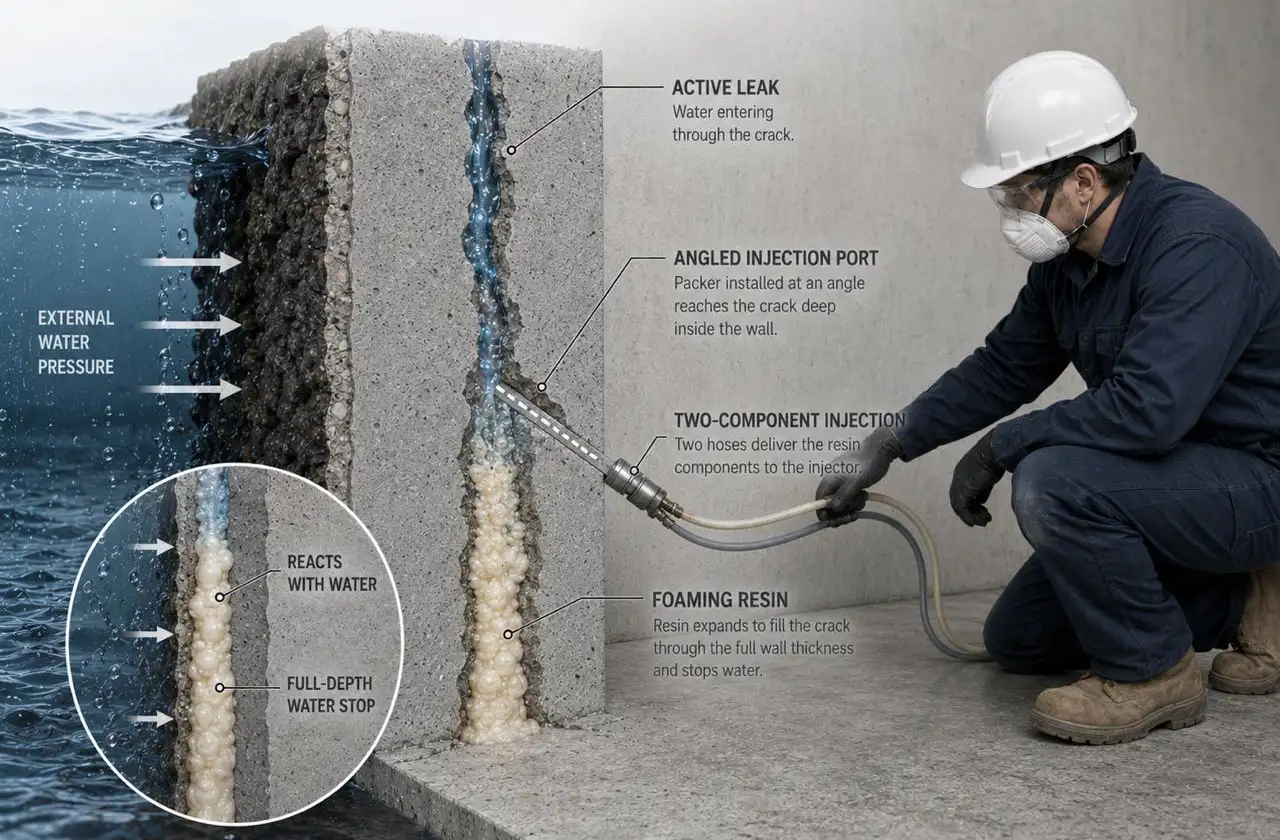
Emergency Water Stop
Active leaks must be controlled before a permanent seal can be installed properly. For this stage, we use Minova CarboStop 402 with CarboStop 402 ACC. This water-reactive polyurethane resin reacts when it contacts water, while the accelerator allows the reaction speed to be adjusted to the site conditions.
This makes it suitable for urgent water-stopping work in areas such as:
- Basements
- Elevator pits
- Tunnels
- Underground structures
- High-pressure water inflow conditions
Permanent Flexible Crack Seal
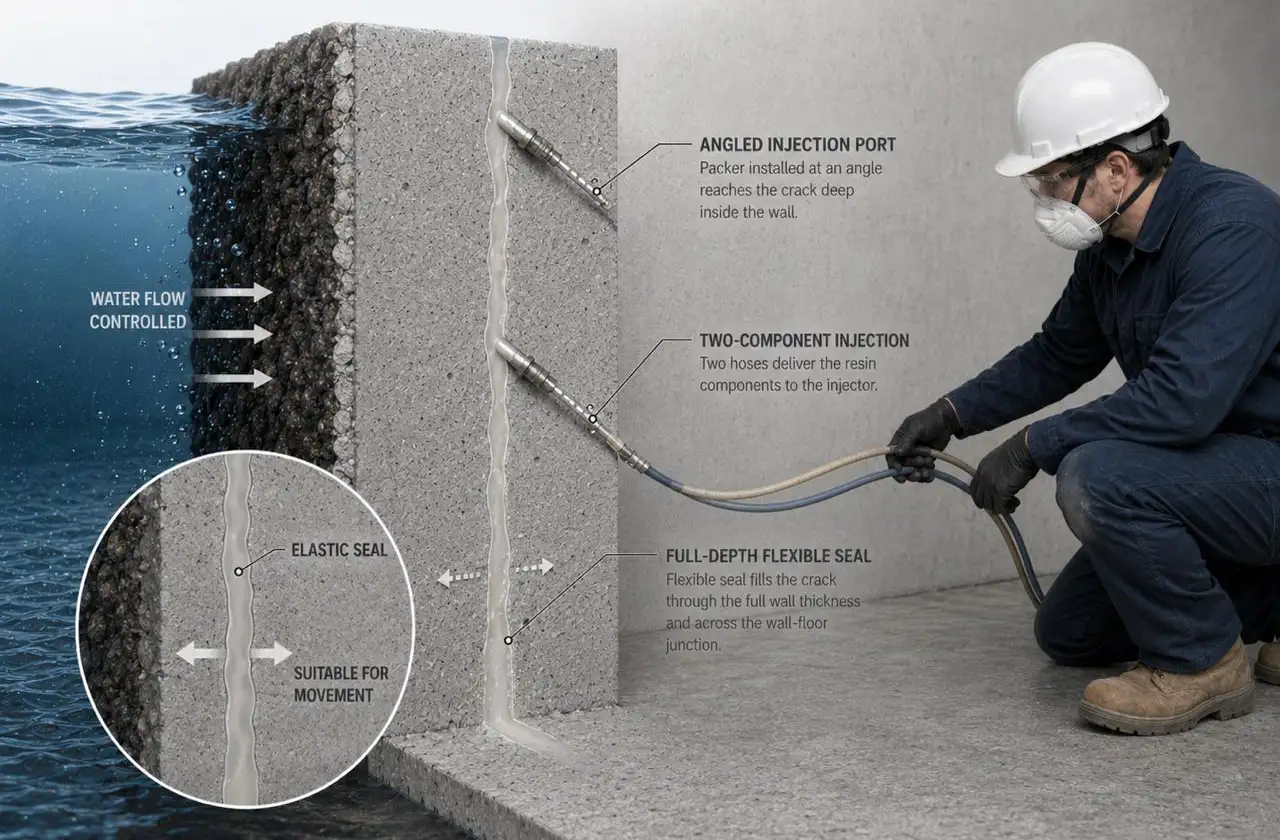
Once the active water flow is controlled, the crack still needs a durable, flexible seal. For this stage, we use Minova CarboCrackSeal H Plus, a two-component polyurethane resin designed for grouting, sealing, and elastic connection of fissures and cavities in concrete and masonry.
Unlike rigid epoxy, this resin remains flexible after curing. It has 192% elongation at break and Shore A 55 hardness, making it suitable for cracks where minor movement may continue over time.
This stage creates the long-term waterproofing seal inside the crack.
Concrete Matrix Protection
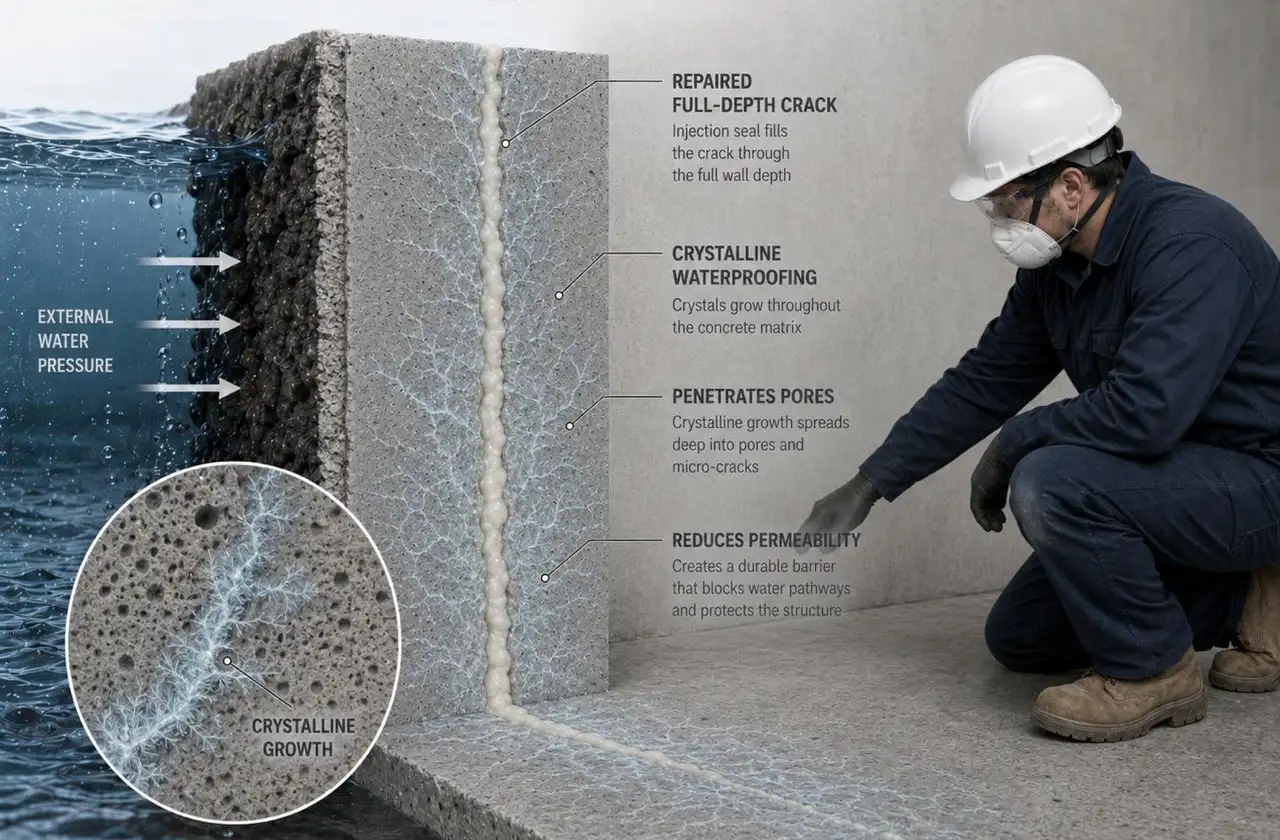
A leak is not always limited to one visible crack. Water often moves through pores, micro-cracks, and weak zones in the surrounding concrete.
After injection curing, we apply Krystol T1 crystalline waterproofing to protect the surrounding concrete matrix. Krystol T1 penetrates the concrete pores, reduces permeability, and can self-seal hairline cracks up to 0.5 mm.
This final stage helps protect the concrete beyond the injected crack line itself.
Active Leak Repair Using Minova
Why We Avoid Single-Product Leak Repairs
Many leak repairs rely on one product for every condition. In our experience, that approach can leave important parts of the problem unresolved.
Common limitations include:
- Water-reactive foams may stop water quickly but may not provide the best long-term crack seal on their own.
- Structural epoxy is designed for dry, static cracks and is not the right first choice for active water leaks.
- A single injection may seal the visible crack while leaving the surrounding concrete vulnerable to future water movement.
Our system separates emergency water control, flexible crack sealing, and concrete matrix protection into three distinct steps.
Why Minova?
Minova injection systems are widely used in demanding infrastructure and underground applications, including tunnels, civil structures, mining, and high-pressure water environments.
We choose Minova because its injection products are designed for site-controlled reaction times, active water conditions, and flexible waterproofing performance.
For active concrete leaks, that matters. The right repair is not just about filling a crack. It is about controlling water, sealing movement, and protecting the concrete around the leak. Minova waterproofing solution products are available in Canada through CCRI, a trained and certified Minova application partner.
Minova vs. Epoxy for Active Concrete Leaks
Epoxy is commonly used for structural concrete crack repair, especially when the crack is dry, static, and needs strength restoration. However, epoxy is not the best first choice for active water leaks.
Active leaks require a material that can react in wet conditions, control water flow, and remain flexible after curing. Rigid epoxy can struggle when water is present or when the concrete continues to move.
That is why we use a Minova-based polyurethane injection system for active leaks. The first stage stops water intrusion, and the second stage creates a flexible waterproof seal inside the crack.
Minova vs. Standard Polyurethane Leak Repairs
Polyurethane injection is widely used for concrete leak repair, and many systems can stop water effectively. The difference is in the repair strategy.
A single polyurethane injection may stop the visible leak, but it does not always address the full problem. Active leaks often involve water movement through the surrounding concrete, micro-cracks, pores, and weak zones around the main crack.
Our Minova-based method separates the repair into three stages: emergency water stop, permanent flexible sealing, and concrete matrix protection. This gives us more control over the repair and helps reduce the risk of future water penetration around the original leak area.